Solution — Thermal Crack Management

Plan the pour.
Control the crack.

Simulate concrete temperature rise, assess crack risk, review restraint and construction sequence, and verify actual site performance with monitoring records.

Established StandardsProject Specification ReadyReal-Time Verification
Need only live temperature monitoring? Mass Concrete Temperature Monitoring →
Pile Cap B4 · Thermal Assessment
Monitoring Active
Crack Risk
Low
Peak Temp
64.2
°C
Differential
17.4
°C
Crack Width
<0.2
mm pred.
Pred. Core
Pred. Surface
75°C Limit
80°65°50°30°CastDay 1Day 3Day 5Day 7
Common Questions

Questions this page helps answer

?
Will this pour exceed project temperature limits?
?
What if the thermal profile exceeds the prescriptive requirement?
?
Is the predicted crack width still acceptable?
?
How does construction sequence affect restraint and crack risk?
?
Where should sensors be placed for useful verification data?
?
How do we document the decision after casting?

Prescriptive limits are important control references. The key is understanding what the thermal behaviour means for crack risk, durability, sequence, and documentation.

Try a simple check with basic project inputs →
The Problem

Thermal cracking is not only about temperature.

Crack risk changes with restraint, construction sequence, geometry, timing, and curing measures.

01
No certainty before casting

Thermal profile, restraint, and crack risk are often assessed after the pour plan is already fixed.

02
Sequence changes the risk

The same element can behave differently depending on pour sequence, adjacent restraint, joint location, and formwork removal timing.

03
Data needs interpretation

Temperature readings alone do not explain crack risk. QA/QC teams need technical context, assumptions, and records.

Fig — Thermal crack mechanism
Heat Generation
Mix hydration
& pour volume
Cooling Phase
Temperature
differential
Restraint Condition
Base, joints,
adjacent pours
Tensile Strain
vs developing
tensile capacity
Crack Risk
Width, location,
extent
For projects that only need live temperature readings and alerts:Mass Concrete Temperature Monitoring →
ConcreteAI Solution

Simulate. Assess. Verify.

Model thermal behaviour before casting, review restraint and crack risk, then verify actual site performance against the planned profile.

01
Simulate

Model the mix, geometry, placing temperature, insulation, formwork, and restraint assumptions before casting.

02
Assess

Review peak temperature, temperature differential, construction sequence, restraint condition, tensile strain, and predicted crack width.

03
Verify

Compare actual site monitoring records against the planned thermal profile and document the decision.

SmartHub sensors →
Simulate
Assess
Verify
Document
Full Workflow

Assess the thermal profile before casting. Verify it during curing.

1
Define the project condition

Mix design, geometry, reinforcement, placing temperature, insulation, formwork, ambient condition, and construction sequence.

Mix designElement geometryPlacing temperaturePour sequenceFormwork plan
2
Model temperature development

Estimate peak temperature, core-surface differential, and temperature-time profile.

Peak temperatureCore-surface differentialTemperature-time profile
3
Review restraint and crack risk

Assess how sequence, adjacent pours, supports, joints, and formwork removal affect crack risk.

Restraint factorsTensile strainPredicted crack width
4
Compare mitigation options

Review lower placing temperature, longer insulation, adjusted pour sequence, revised formwork timing, or other control measures.

5
Verify and document

Use monitoring records to compare predicted vs actual behaviour and support project decisions.

Predicted Thermal Profile
Pred. Core
Pred. Surface
75°C limit
80°70°55°40°25°75°C limit72.1°C pred.CastDay 1Day 3Day 5Day 7

Predicted core and surface temperature profile. Project temperature limit shown in red.

Scenario Comparison — Mitigation Options
ScenarioChange ReviewedThermal ImpactCrack RiskRecommendation
AOriginal sequenceHigher differentialReviewImprove control
BLonger insulationLower differential✓ LowerPreferred
CLower placing temp.Lower peak✓ LowerConsider
Why It Helps

A clearer basis for QA/QC and technical decisions.

Review sequence and restraint

Understand how construction sequence and restraint conditions change crack risk before committing the pour plan.

Optimise control measures

Compare insulation, placing temperature, formwork timing, and pour sequence before committing resources.

Reduce disputes and rework

Use evidence-based records to reduce uncertainty around cracking, repair responsibility, and compliance discussions.

Applications

For concrete elements where thermal behaviour needs technical review.
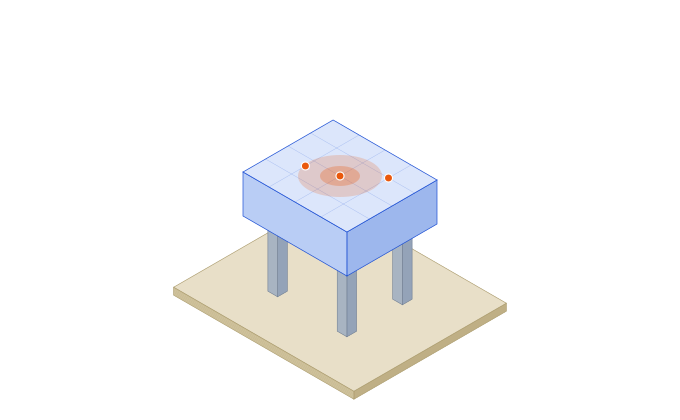
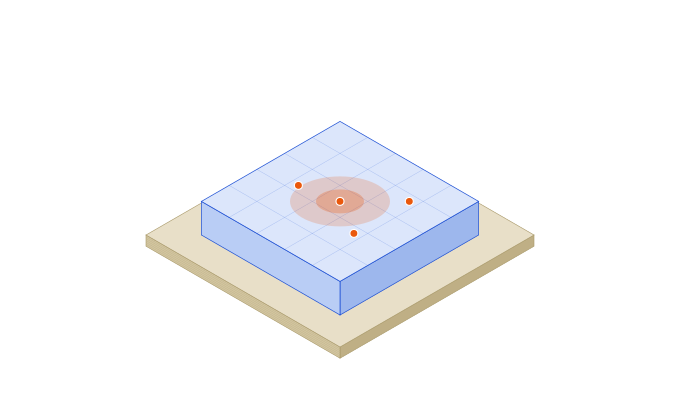
Pile cap thermal monitoring
Pile Caps & Raft Foundations
Mat slab and raft foundation thermal monitoring
Base Slabs & Basement Structures
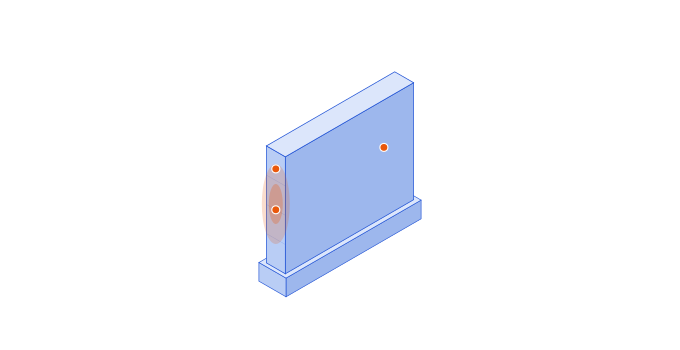
Retaining wall thermal monitoring
Thick Walls & Retaining Walls
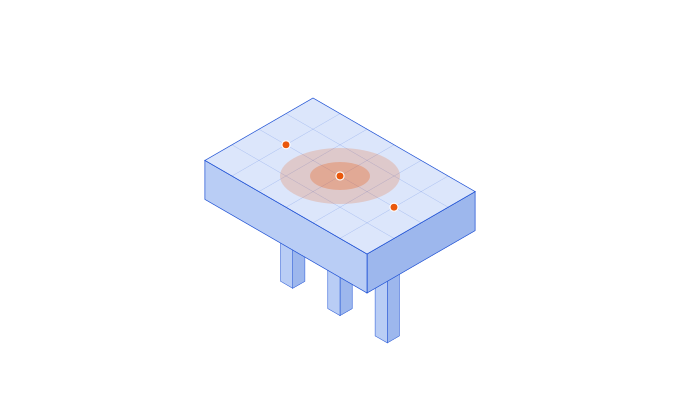
Transfer deck thermal monitoring
Transfer Slabs & Transfer Beams
Tunnel lining thermal monitoring
MRT Stations, Shafts & Tunnels
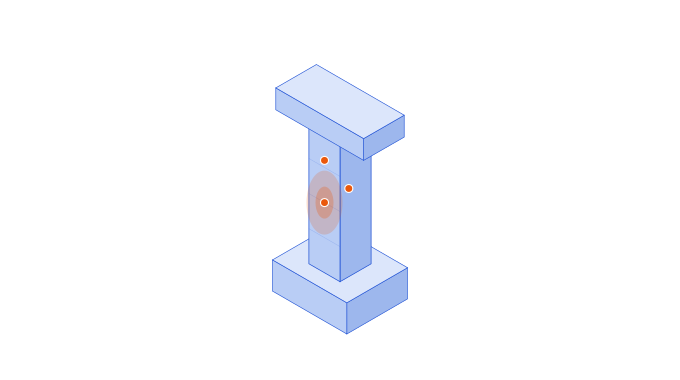
Bridge pier thermal monitoring
Bridge Piers & Infrastructure Substructures
Resources

Go deeper or start with a simple check.

Interactive Tool
Try Simple Thermal Crack Check

Enter basic inputs to get an initial view of thermal risk factors.

Open Simple Check →
Flyer Download
Download Product Flyer

A concise overview of the thermal crack management solution — suitable for sharing with project teams and consultants.

Coming soon
Technical Note
Prescriptive Limits vs Thermal Crack Risk

Understand why project limits are useful control references, and why exceedances need technical context.

Coming soon
FAQ

Common questions

Thermal cracking is caused by temperature rise, cooling, shrinkage, and restraint during early-age concrete development. When the induced tensile strain exceeds the concrete's developing tensile capacity, cracks can form.
Pile caps, raft foundations, thick slabs, transfer structures, thick walls, basement structures, station boxes, shafts, and other restrained or large-volume concrete elements are commonly at risk.
No. The solution is useful for mass concrete, but also for restrained structural elements where thermal movement, shrinkage, and crack width control are important.
A prescriptive limit exceedance does not automatically mean cracking has occurred or will occur. It means the risk should be reviewed in the context of the actual crack risk, restraint condition, construction sequence, and remediation options available.

Read the full technical note on prescriptive limits →
Typical inputs include drawings, element dimensions, mix design, placing temperature, formwork and insulation plan, pour sequence, reinforcement details, and project crack width requirements.
Simulation predicts expected performance before casting. Monitoring verifies actual site behaviour and helps the team take action if measured temperatures or differentials deviate from the plan.
Related Solution
Need only live temperature monitoring without full crack analysis?

Mass Concrete Temperature Monitoring provides real-time core and surface temperature tracking — wireless, continuously logged, and compliance-ready.

Mass Concrete Temperature Monitoring →

Assess thermal crack risk before your next pour.

Start with a simple check, or send your project details for a more complete review of thermal profile, restraint condition, construction sequence, crack risk, and monitoring approach.

Try Simple Thermal Crack Check →Send Project Enquiry

For project-specific review, include drawings, mix design, pour sequence, formwork and insulation plan, and project temperature requirements.